


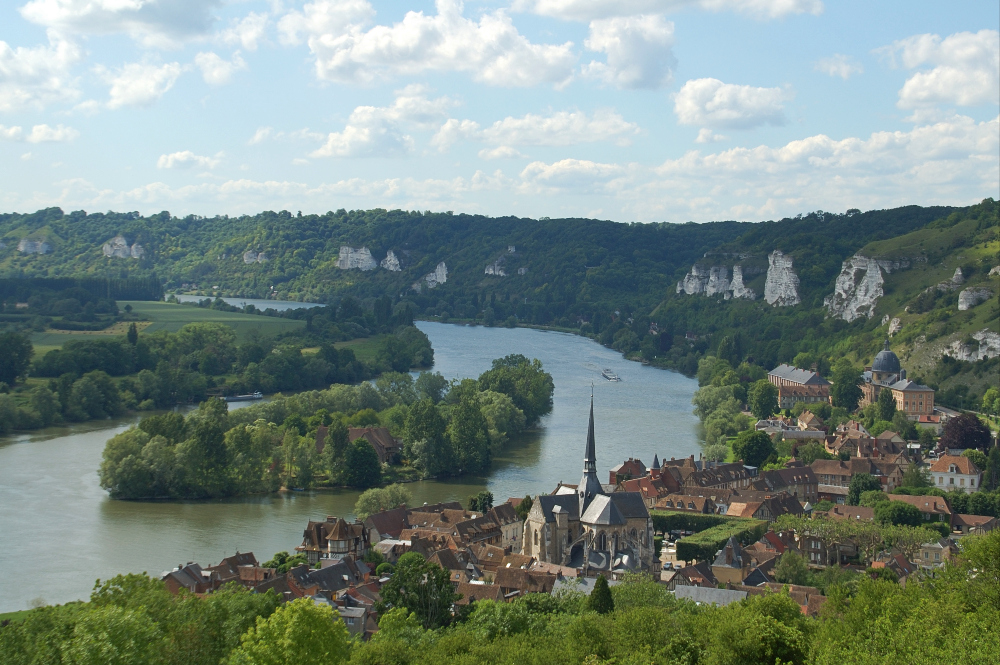
Did you know that France has no less than 430,000 km of rivers (not counting overseas territories)? In French, there are as many as 10 different words related to rivers. It is time to get to know them!
1. Le fleuve
A river that always flows into the sea. France has 7 major ‘fleuves’: the Adour, the Garonne, the Loire, the Meuse, the Rhine, the Rhône, and the Seine.
2. La rivière
Be careful, not all rivers are called une rivière. Only a river that flows into another river is a rivière. It is also smaller than une fleuve. An example is the Saône, which joins the Rhône at Lyon.
3. La bassin fluvial
This is what you call the drainage basin of a river before it reaches the sea. For example, Brittany is the drainage basin of the Loire. Normandy belongs to the Seine, and Picardy to the Artois and the Somme.
4. Ruisseau
A brook or a stream.
5. Les méandres
These are rivers that wind and zigzag through the landscape (indeed, we are familiar with the word meander).
6. La source
The source, the birthplace of a body of water. You find it at the highest point of the river. For instance, the source of the Garonne is in the Pyrenees, just across the Spanish border. The Loire originates in the Ardèche, on Mont Gerbier-de-Jonc. The Seine begins on the Langres plateau, where other rivers such as the Marne, the Aube, and our ‘own’ Meuse also originate.
7. Un affluent / tributaire
This is a river that originates from another river or a lake. The Durance, for example, is un affluent of the Rhône. The Meurthe is a tributary of the Moselle, which in turn is a tributary of the Rhine.
8. Le débit
This is the term for discharge: the volume of water passing through a riverbed (le lit). If the current is too strong, the river may overflow its banks (la rivière déborde). If things go wrong, you have a flood (une inondation).
9. L’embouchure
This is the term for the mouth of a river.
10. L’estuaire
The part of a river mouth influenced by the tides is un estuaire.


